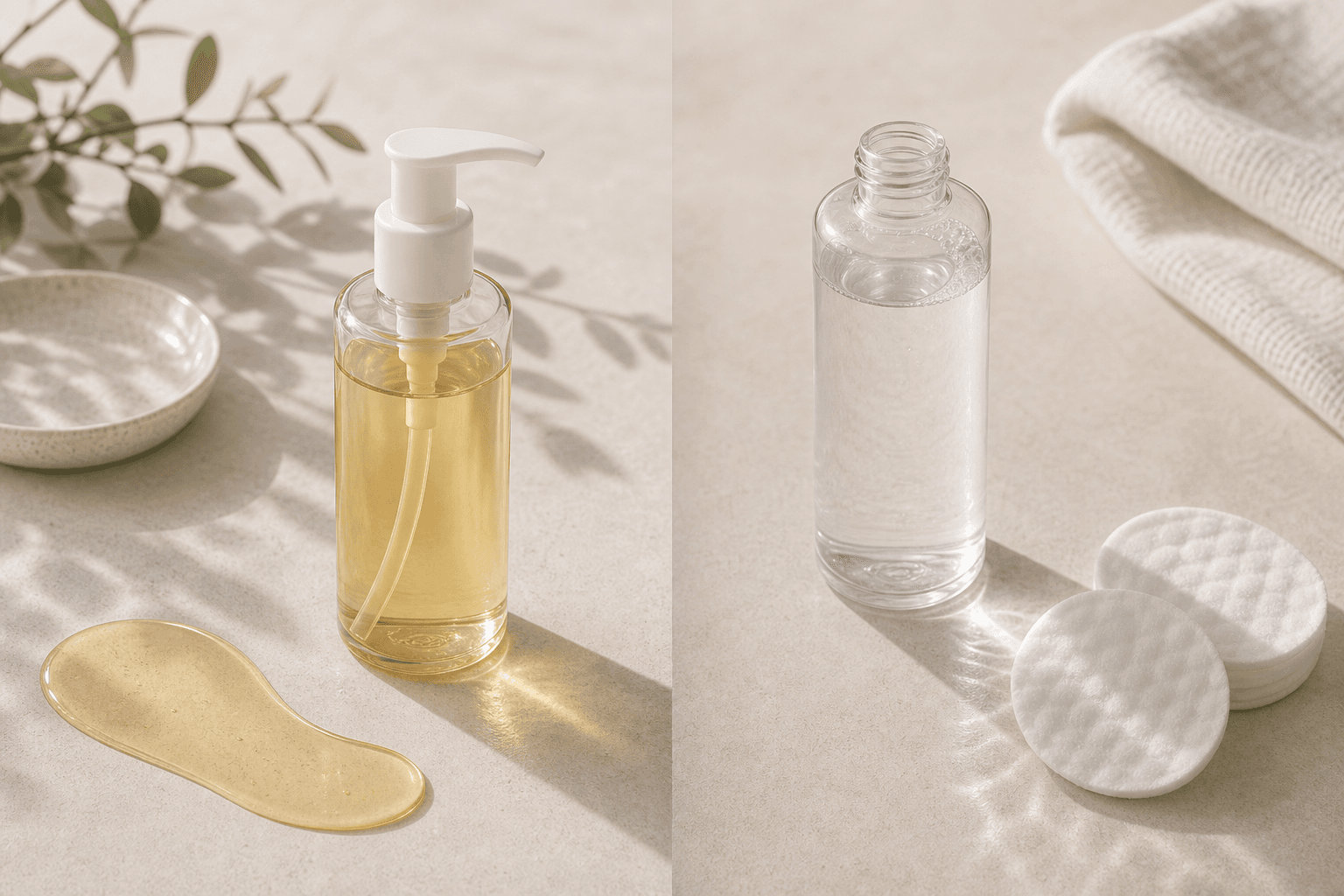
Start with what you need to remove
The first cleanse should answer the day you actually had. Water-resistant sunscreen, long-wear base makeup, and heavier pigments usually need a more thorough removal step than a bare-skin day with light sunscreen. Beginners get into trouble when they choose the category before they define the job.
Oil cleanser suits heavier daily removal
An oil cleanser or cleansing balm often makes sense when sunscreen, makeup, or sebum-heavy buildup needs to break down before a gentle second cleanse. The advantage is slip: it can loosen product without scrubby pressure. The mistake is using too much friction, rinsing poorly, or following it with a second cleanser that leaves the skin tight.
Micellar water suits lighter or lower-commitment routines
Micellar water can be useful when the routine needs something quick, travel-friendly, or lighter than a full oil cleanse. It is not automatically gentler, though. If the user rubs with cotton pads until the skin looks pink, the method has become the problem. It also may not remove every water-resistant formula cleanly enough on its own. For a buyer-brand inquiry, micellar water should be screened as its own format question: cleansing strength, residue feel, cotton-pad friction, sensitive-skin boundary, bottle format, leak risk, sample quantity, and whether the product should sit as a travel SKU, starter SKU, or support SKU rather than a full first-cleanse replacement.
Do not double-cleanse by default
Double cleansing is useful when there is something meaningful to remove. It is not a badge of routine seriousness. If skin is dry, reactive, or already clean enough after one gentle cleanse, adding an oil cleanser and a water-based cleanser every night may create more stress than clarity. Commercially, that means the inquiry should not ask Korean suppliers for a whole cleansing system before the first job is named. Start with the removal problem, then decide whether the Korean partner should review oil cleanser, balm cleanser, micellar water, second cleanser, package compatibility, or a smaller sample test.
Package choice changes the supplier question
Cleanser format is tied to packaging earlier than many buyers expect. A liquid oil raises pump, cap, leakage, viscosity, and travel questions. A balm raises jar, spatula, melt point, fill weight, and heat-stability questions. Micellar water raises bottle size, dispensing, cotton-pad use, and shipping-weight questions. Those details affect sample proof, MOQ realism, and supplier fit before a quote is useful. A stronger Korean skincare inquiry names the likely format, package assumption, target channel, first market, and one package or sample blocker instead of asking for a generic cleanser manufacturer list.
Choose by repeatability, not by trend logic
The right first cleanse should leave the skin comfortable and make the next steps easier to use. If oil cleanser makes sunscreen removal calm and predictable, use it. If micellar water helps the user avoid sleeping in makeup and heavy removal is not needed, it can fit. The better category is the one that cleans the day without turning cleansing into irritation. For OEM/ODM review, repeatability becomes sample acceptance: no tight finish, no heavy residue, no eye-area surprise, no package mess, and no second-step dependency that makes the routine harder to repeat.
Turn cleanser choice into an inquiry
A cleanser lead is stronger when the buyer names company context, target market or buyer region, first SKU/category, use case, format preference, sample purpose, package assumption, MOQ or budget signal, and the stuck decision. Unknown answers can be named directly. The weak request is "send cleanser suppliers." The stronger request is "we need Korean oil cleanser or micellar water review for sunscreen and makeup removal, first market, bottle or balm package fit, sample proof, MOQ 1000+ feasibility, and whether stock formula screening or custom ODM formulation is the responsible route."